2026 Best Feed for Shrimp Farming What Feed Is Best?

Time:2026-10-02 Author:Amelia
0%

Choosing the right feed can determine shrimp growth, water quality, harvest size, and farm profitability. Yet, what feed is best for shrimp farming depends on species, growth stage, stocking density, and pond conditions. A feed that performs well in a warm, aerated pond may disappoint during cloudy weather or sudden temperature changes.

High-quality shrimp feed usually contains balanced protein, digestible energy, essential amino acids, minerals, and stable vitamins. Pellet size matters too. Small post-larvae need fine particles, while larger shrimp require pellets that sink slowly and remain firm. Good water stability reduces waste on the pond bottom. That matters.

Farmers should examine feeding response, feed conversion ratio, survival, and shrimp growth instead of trusting labels alone. A practical test involves checking feeding trays after two or three hours. Uneaten pellets can signal overfeeding, stress, poor palatability, or unhealthy shrimp. These clues deserve attention.

There is no perfect feed for every farm. Experienced producers adjust feeding rates after observing weather, molting activity, dissolved oxygen, and water color. Independent nutritionists, hatchery specialists, and reputable feed manufacturers can provide useful guidance, but their advice should match local evidence. Keep simple records.

This guide reviews the best feed choices for shrimp farming in 2026, including commercial pellets, functional feeds, and stage-specific formulas. It also considers ingredient quality, pellet performance, storage conditions, and farm economics. Some recommendations may need adjustment. That is part of responsible farming.
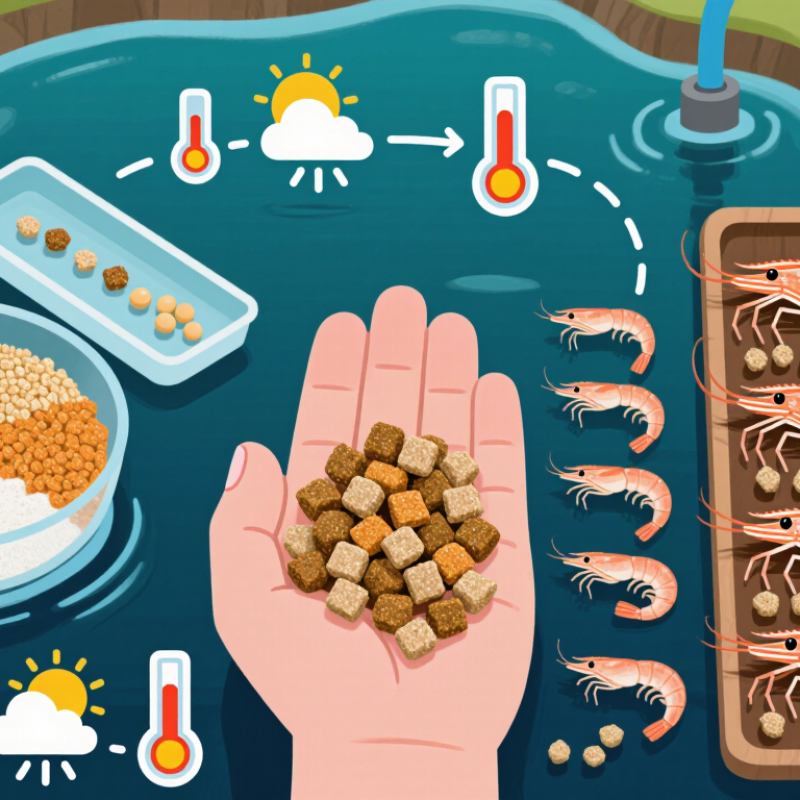
2026 Best Feed for Shrimp Farming What Feed Is Best?

Species and Growth Stage: Match Feed to P. vannamei Needs (FAO)

For P. vannamei, the best feed changes with body size, water quality, and farming intensity. FAO reports that aquaculture produced 94.4 million tonnes of aquatic animals in 2022, representing 51% of global aquatic animal production. This scale makes feed precision essential.

A nursery shrimp needs small, water-stable particles and highly digestible protein. Crumbles or fine pellets should match the shrimp’s mouth size. Oversized feed sinks untouched.

Protein should not be selected by percentage alone. Practical farm programs often use higher protein during nursery and early grow-out, commonly around 35–40%, then reduce it toward 30–35% as shrimp become larger.

Energy, amino-acid balance, minerals, and pellet stability also matter. The FAO and NRC guidance both emphasize species-specific nutrient requirements, rather than one universal formula.

Feed size must follow growth. Check the gut, not only the feeding tray.

At 3–5 grams, P. vannamei may accept a small sinking pellet, while larger shrimp need a stronger pellet that survives handling and water movement. Feeding trays can reveal uneaten particles within 30–60 minutes.

That observation is useful, but imperfect. Wind, dissolved oxygen, and algal blooms can change appetite quickly. I would adjust cautiously, often by 5–10%, instead of making a dramatic correction.

A 2024 shrimp farming review also links feed efficiency closely with survival, biomass gain, and water quality. The cheapest feed is not always the lowest-cost feed.

Nutrient Formula: Target 35–40% Protein and Essential Lipids

2026 Best Feed for Shrimp Farming: What Feed Is Best?

For 2026 shrimp farming, the best feed starts with a measured nutrient formula, not a fashionable label. Aim for 35–40% crude protein during active juvenile growth, then adjust for species, temperature, and stocking density. Protein supports muscle, molting, and tissue repair, but excess protein can raise waste when shrimp cannot use it efficiently. A practical ration also needs essential lipids, including phospholipids, cholesterol, and suitable omega-3 fatty acids. These nutrients support cell membranes, energy storage, molting, and larval development. Feed quality matters beyond percentages. Fresh pellets should hold shape briefly, sink predictably, and resist rapid nutrient loss.

Tips: Compare feed intake with feeding trays, not guesses. Check uneaten pellets after 30–60 minutes and reduce the next portion when waste appears. Store feed cool, dry, and sealed. Rancid lipids can reduce palatability and weaken performance. Keep records of survival, weight gain, molt timing, and water clarity. Small changes reveal more than one dramatic adjustment. Still, practice is imperfect. A formula that performs well in one pond may disappoint in another. Salinity, oxygen, natural productivity, and pellet size can change results.

During farm evaluations, begin near the 35–40% protein range and monitor feed conversion closely. Do not raise protein automatically after slow growth. Inspect dissolved oxygen, temperature, gut fullness, and pellet stability first. Essential lipids deserve equal attention. Shrimp may show poor molting or weak growth when lipid balance is inadequate, even with enough protein. Request a complete nutrient specification, including moisture, ash, lipid level, and fatty-acid sources. Independent laboratory checks help when results conflict with the feed label. No formula works perfectly everywhere. The pond remains the final test.

Pellet Quality: Use 0.8–2.0 mm Pellets with High Water Stability

2026 Best Feed for Shrimp Farming: What Feed Is Best?

Pellet quality often decides whether feed becomes shrimp growth or pond waste. For most nursery and grow-out stages, 0.8–2.0 mm pellets offer practical size control. Smaller shrimp need fine pellets, while larger shrimp handle wider particles. The correct size should match mouth opening and feeding response, not only culture charts. High water stability also matters. A pellet that remains intact for several hours protects nutrients from rapid leaching. It also keeps the feeding tray cleaner.

FAO’s State of World Fisheries and Aquaculture 2024 reported 94.4 million tonnes of aquatic animals from aquaculture in 2022. Alltech’s Agri-Food Outlook 2024 estimated global aqua-feed production at roughly 53 million tonnes in 2023. These figures show the scale of feed use, but volume alone proves nothing about quality. In pond checks, watch pellet hardness, sinking speed, smell, and leftover fragments. A strong pellet is not automatically digestible. This is where many farms need better judgment.

Tips: Test a small feed sample in pond water before buying in bulk. Check the pellet after 30, 60, and 120 minutes. If it swells, breaks, or clouds the water quickly, review its binder and processing quality. Keep feeding trays at several pond points. Shrimp do not always gather evenly. Records should include size, feeding time, weather, survival estimates, and uneaten feed. Mistakes happen. Adjust slowly, not emotionally.

2026 Best Feed for Shrimp Farming What Feed Is Best? - Pellet Quality: Use 0.8–2.0 mm Pellets with High Water Stability
Practical feed-selection reference for intensive and semi-intensive shrimp culture. Values are typical target ranges and should be adjusted for species, water temperature, biomass, feed formulation, and farm conditions.
Recommended Pellet Specifications by Shrimp Growth Stage
Growth Stage Approximate Shrimp Size Recommended Pellet Diameter Typical Crude Protein Range Water Stability Target Suggested Feeding Frequency Important Quality Indicators
Postlarvae / Nursery 0.02–0.20 g 0.3–0.6 mm micro-pellets or crumble 40–45% At least 80% pellet integrity after 1 hour 5–8 meals per day Small uniform particles, low dust, rapid acceptance, and no visible mold or rancid odor
Early Juvenile 0.20–2 g 0.6–0.8 mm 38–43% At least 85% pellet integrity after 1–2 hours 4–6 meals per day Consistent diameter, good sinking behavior, low fines, and adequate attractability
Juvenile 2–8 g 0.8–1.2 mm 35–40% At least 85–90% pellet integrity after 2 hours 4–6 meals per day Firm pellets, limited swelling, stable water color, and minimal nutrient leaching
Grow-Out 8–20 g 1.2–1.6 mm 32–38% At least 90% pellet integrity after 2 hours 3–5 meals per day Uniform sinking rate, strong water stability, low breakage during transport, and good feed response
Late Grow-Out 20–30 g or larger 1.6–2.0 mm 30–36% At least 90% pellet integrity after 2 hours 3–4 meals per day Pellets should remain intact long enough for feeding without creating excessive bottom waste
Core Pellet-Quality Checks for Shrimp Feed
Quality Dimension Recommended Practical Target Why It Matters in Shrimp Farming Simple Farm-Level Check
Pellet Diameter 0.8–2.0 mm for most juvenile and grow-out stages Correct size improves ingestion, reduces competition, and limits uneaten feed Measure several pellets with a caliper and check size uniformity across the bag
Water Stability At least 85–90% physical integrity after approximately 2 hours for grow-out feed Reduces nutrient leaching, turbidity, organic loading, and bottom sludge formation Place a known quantity in pond water and inspect pellet structure at 30, 60, and 120 minutes
Pellet Hardness Firm enough to resist handling damage, but not excessively hard for the shrimp size Prevents fines and allows shrimp to consume the feed efficiently Check for excessive crumbling when gently pressed or poured between containers
Fines and Dust As little loose powder as possible; ideally no visible accumulation at the bottom of the bag Fines dissolve rapidly and can worsen water quality before they are eaten Sieve a small sample and visually inspect the amount of powder and broken pellets
Moisture Control Generally about 8–12% in finished dry feed, depending on formulation and storage conditions Excess moisture increases the risk of mold, caking, deterioration, and nutrient loss Check for swollen bags, clumping, unusual warmth, or musty odor; laboratory testing is preferred
Sinking Behavior Consistent sinking with no prolonged floating or rapid disintegration Shrimp feed mainly on the pond bottom; predictable sinking supports tray and biomass management Observe a small sample in pond water and record the sinking time and pellet condition
Freshness and Odor Clean marine or cereal-like odor; no rancid, sour, chemical, or moldy smell Oxidized fats and spoiled ingredients may reduce palatability and feed intake Open a fresh bag and compare odor, color, and texture with the product specification
Storage Stability Store in a cool, dry, ventilated area on pallets, away from walls, sunlight, chemicals, and rodents Heat and humidity accelerate lipid oxidation, vitamin loss, mold growth, and pellet degradation Use first-in, first-out inventory control and keep bags sealed until use

Feeding Management: Start at 2–5% of Biomass and Check Feeding Trays

In shrimp farming, feed should match biomass, water quality, shrimp size, and daily appetite. A useful starting point is 2–5% of estimated biomass each day. Smaller shrimp often need the higher rate, while larger shrimp may need less. This range is guidance, not a fixed prescription. Keep it measurable.

Place feeding trays at several pond locations, including areas with different water movement. Put feed on each tray after broadcasting or distributing it evenly. Check the trays after two to three hours, then adjust the next meal. Empty trays suggest underfeeding, but heavy leftovers can reduce water quality.

Do not guess. Temperature, dissolved oxygen, moulting, rainfall, and stress can change consumption quickly.

Record the offered feed, tray remains, weather, water readings, and estimated survival. Recalculate biomass after sampling, rather than relying on an old stocking estimate. Feed size also matters; shrimp should capture pellets before they soften or drift away. In practice, a clean tray does not always prove perfect feeding. Currents may move pellets. That is where judgment becomes difficult. Review the records weekly, and change the ration gradually instead of making sharp corrections.

Performance Testing: Compare FCR 1.2–1.8, Survival, and Cost per Kilogram

Choosing the best shrimp feed in 2026 requires farm-level performance testing, not advertising claims. FCR measures feed used against shrimp weight gained. A trial result between 1.2 and 1.8 can change profit significantly. However, lower FCR is not always better. Poor sampling may hide slow-growing shrimp or losses near pond edges.

Run several pond trials under similar stocking density, salinity, temperature, and feeding schedules. Record daily feed amounts, weekly biomass, survival, and water quality. Use feeding trays to check leftovers after two hours. A practical trial should last through a meaningful growth period, not only ten convenient days. Keep weather notes. Heavy rain can distort appetite and dissolved oxygen.

Calculate feed cost per kilogram of harvested shrimp, including feed price, survival, and final biomass. A cheaper diet may produce an FCR of 1.8 and weaker survival. A higher-priced diet may reach 1.3, but only if shrimp remain healthy and reach market size.

For example, 1,000 kilograms of shrimp harvested at an FCR of 1.2 require about 1,200 kilograms of feed. At 1.8, the requirement rises to 1,800 kilograms. The difference is substantial.

Do not trust one pond.

Farm records can be messy. Weighing errors, uneven shrimp sizes, and missed feedings can weaken conclusions. Repeat the comparison across seasons and stocking cycles. Independent laboratory checks for nutrient quality can improve confidence, while clear records make the final decision more defensible.

FAQS

What protein level suits shrimp during active juvenile growth?

A practical starting range is 35–40% crude protein. Protein supports muscle growth, molting, and tissue repair. More protein is not automatically better. Unused protein may increase pond waste.

Which lipids should shrimp feed provide?

Look for phospholipids, cholesterol, and suitable omega-3 fatty acids. These support cell membranes, energy storage, molting, and larval development. A protein-rich formula can still perform poorly with weak lipid balance. That detail is easy to miss.

How much feed should be offered daily?

Start near 2–5% of estimated shrimp biomass per day. Smaller shrimp often need the higher rate. Larger shrimp may require less. This is guidance, not a fixed prescription.

How can feeding trays improve ration decisions?

Place trays in several pond areas with different water movement. Check them after two to three hours. Heavy leftovers suggest reducing the next meal. An empty tray does not always prove underfeeding. Currents may have moved the pellets.

What feed quality details should farmers inspect?

Fresh pellets should briefly hold their shape and sink predictably. They should resist rapid nutrient loss. Check moisture, ash, lipid levels, and fatty-acid sources. Soft pellets may drift away before shrimp capture them.

How should shrimp feed be stored?

Keep feed cool, dry, sealed, and away from moisture. Inspect its smell and texture before use. Rancid lipids can reduce appetite and weaken performance. Small storage mistakes can become expensive.

What FCR range may indicate useful feed performance?

Farm trials often compare FCR results around 1.2–1.8. At 1,000 kilograms harvested, FCR 1.2 requires about 1,200 kilograms of feed. FCR 1.8 requires about 1,800 kilograms. Lower FCR is not always better if survival suffers.

How should farmers compare different feeds fairly?

Test them across ponds with similar density, salinity, temperature, and feeding schedules. Record feed amounts, weekly biomass, survival, weather, and water quality. Continue through a meaningful growth period. Do not trust one pond. Sampling errors can mislead the decision.

Why might good feed perform poorly in one pond?

Salinity, oxygen, temperature, natural productivity, and pellet size can change results. Rainfall may reduce appetite and dissolved oxygen quickly. Molt timing and stress also affect feeding. The formula may not be the only problem. The pond remains the final test.

Conclusion

Choosing what feed is best for shrimp farming depends on the shrimp species, growth stage, and production goals. For P. vannamei, feed should be adjusted from nursery to grow-out stages to support steady development. A balanced formula with approximately 35–40% protein, suitable essential lipids, vitamins, and minerals can help maintain growth and health. Pellet size should match shrimp size, generally ranging from 0.8 to 2.0 mm, while strong water stability helps reduce nutrient loss and maintain pond quality.

Effective feeding management is equally important. Begin with roughly 2–5% of total shrimp biomass per day, then adjust according to temperature, appetite, biomass, and growth results. Feeding trays can show whether shrimp are consuming the offered amount and help prevent overfeeding. When comparing feeds, evaluate feed conversion ratio, with a practical target of about 1.2–1.8, along with survival rate and total cost per kilogram of shrimp produced. The best feed is the one that delivers consistent performance and economical results.

Amelia

Amelia

Amelia is a seasoned marketing professional with a wealth of expertise in our company’s core offerings. With an unwavering passion for driving growth and innovation, she plays a pivotal role in shaping our marketing strategies and enhancing brand visibility. A key aspect of her responsibilities......