How do probiotics help in aquaculture feed? They introduce beneficial microorganisms that may support digestion, influence gut microbial balance, and help fish or shrimp respond to everyday production stress. In practical terms, these microbes are delivered through feed, where they encounter changing conditions: warm water, shifting oxygen levels, handling, and differences in feed quality. Their effects depend on the species, probiotic strain, dose, and farm environment. There is no single formula.
A well-chosen probiotic may produce enzymes that help break down nutrients, making proteins or other feed components easier to use. Some strains can also compete with unwanted microbes for space and nutrients. Others may interact with the host’s immune response. These are potential mechanisms, not guaranteed outcomes. A better-looking pond does not prove that a probiotic caused the change.
The details matter. A product must remain viable during storage and feed processing, and its instructions should match the cultured species and life stage. Farm teams can track feed intake, growth, survival, and water conditions before and after use. Keep records. Small differences can be hard to interpret, especially when temperature or stocking density changes at the same time. Probiotics may support a broader management plan, but they cannot replace clean water, sound nutrition, or careful disease monitoring. Results may be modest. That deserves attention, too. This guide explores how probiotics work in aquaculture feed, what evidence can tell farmers, and which practical questions to ask before choosing a product.
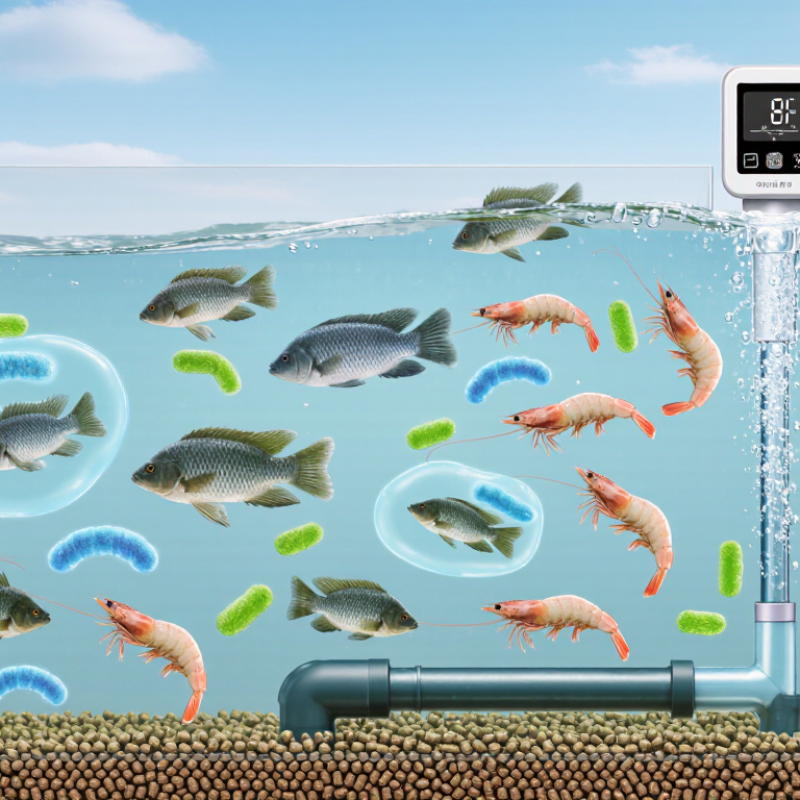
Probiotics used in aquaculture feed are usually selected from Bacillus bacteria, lactic acid bacteria, and yeasts. Commonly studied examples include Bacillus subtilis, B. licheniformis, Lactiplantibacillus plantarum, and Saccharomyces cerevisiae. Some products use one strain; others combine several. A blend is not automatically better. Strains can behave differently in fish, shrimp, and different water conditions (Hoseinifar et al., 2018).
Feed form matters. Bacillus spores can tolerate processing and storage better than many non-spore-forming bacteria, while live-cell counts may fall during heat-intensive pelleting. Yeasts are also used, but their effects depend on strain and dose. Check the declared organisms, viable count at the end of shelf life, and feeding-trial evidence—not just the species name.
Scale makes careful selection important. FAO’s 2024 State of World Fisheries and Aquaculture reports 94.4 million tonnes of farmed aquatic animals in 2022, equal to 51% of global aquatic-animal production. That figure describes the sector, not probiotic performance. In practice, a strain tested in one species may not work the same way in another. Results can be uneven. Local feed handling and water quality deserve attention, too.
| Probiotic group and examples | Common aquaculture applications | How they may help | Feed use and practical considerations |
|---|---|---|---|
| Bacillus subtilis and Bacillus licheniformis | Finfish and shrimp diets | Selected strains may produce digestive enzymes, support nutrient utilization, and influence gut microbial communities. | Spore-forming strains can be relatively robust during feed processing, but survival depends on the strain, processing conditions, storage, and formulation. |
| Lactiplantibacillus plantarum (formerly Lactobacillus plantarum) | Finfish and shrimp diets | Some strains may compete with undesirable microbes and contribute to a favorable intestinal environment. | Viability can be affected by heat and moisture. Use strain-specific evidence and follow the feed or additive supplier’s validated instructions. |
| Lacticaseibacillus acidophilus (formerly Lactobacillus acidophilus) | Finfish diets; use in shrimp diets is also reported | Selected strains may support intestinal microbial balance and digestive function. | Effects are not consistent across all strains or cultured species. Confirm viable-cell counts at the point of feeding where possible. |
| Saccharomyces cerevisiae | Finfish and shrimp feeds | Live yeast or yeast-derived components may support gut function and immune responses; effects depend on the preparation and strain. | Distinguish live yeast from inactivated yeast and yeast-cell-wall ingredients, as they are not equivalent products. |
| Enterococcus faecium | Some finfish feed applications | Specific strains have been studied for effects on gut microbiota, digestion, and host responses. | Use only strains assessed for safety and permitted for the intended animal and region; species-level identification alone is not sufficient. |
| Multi-strain blends, such as combinations of Bacillus and lactic acid bacteria | Finfish and shrimp feeds, depending on the formulation | Different strains may provide complementary functions, but a blend is beneficial only if its components are compatible and effective together. | Check strain identities, viable counts, storage requirements, and evidence for the target species. Do not assume that more strains produce better results. |
Important: Probiotic effects are strain-, species-, diet-, and farm-condition dependent. There is no universal inclusion rate or guaranteed outcome. Follow applicable regulations and validated product directions, and consider feed-processing stability and storage when selecting a probiotic.
They can be blended into dry ingredients before pelleting or extrusion. Heat-sensitive cultures may be sprayed onto cooled pellets in a rotating drum.
Yes. Heat and pressure may reduce live-cell counts, though the effect varies by culture and process. One method may not suit every feed.
Warm, damp storage can reduce live counts. Testing after storage gives a clearer picture than checking only at manufacture.
Some strains produce enzymes that help break down feed components. Others can make gut conditions less favorable to certain harmful microbes.
No. Any response may be subtle, and farm conditions can complicate results. One observation is rarely enough.
Strain, animal species, life stage, diet, dose, water temperature, oxygen, and pathogen pressure can all matter.
Compare treated and untreated groups under similar conditions. Record growth, feed conversion, and survival over time.
No. They may support nutrient use, but they cannot replace a well-formulated diet or good water management.
Probiotics used in aquaculture feed commonly include beneficial bacteria and yeasts selected to support a balanced microbial environment in fish. They may be mixed into feed during production or applied after processing, with care taken to preserve their viability. Once consumed, these microorganisms can help break down feed components and support nutrient absorption, potentially allowing fish to make better use of their diet.
So, how do probiotics help in aquaculture feed? They can also contribute to fish health by supporting natural defenses and making it harder for harmful microbes to thrive. Their results depend on factors such as the probiotic strain, dosage, feed storage, water conditions, fish species, and feeding practices. Choosing suitable probiotics and maintaining consistent, appropriate use are important for achieving reliable benefits.

 Pawlix Pet